
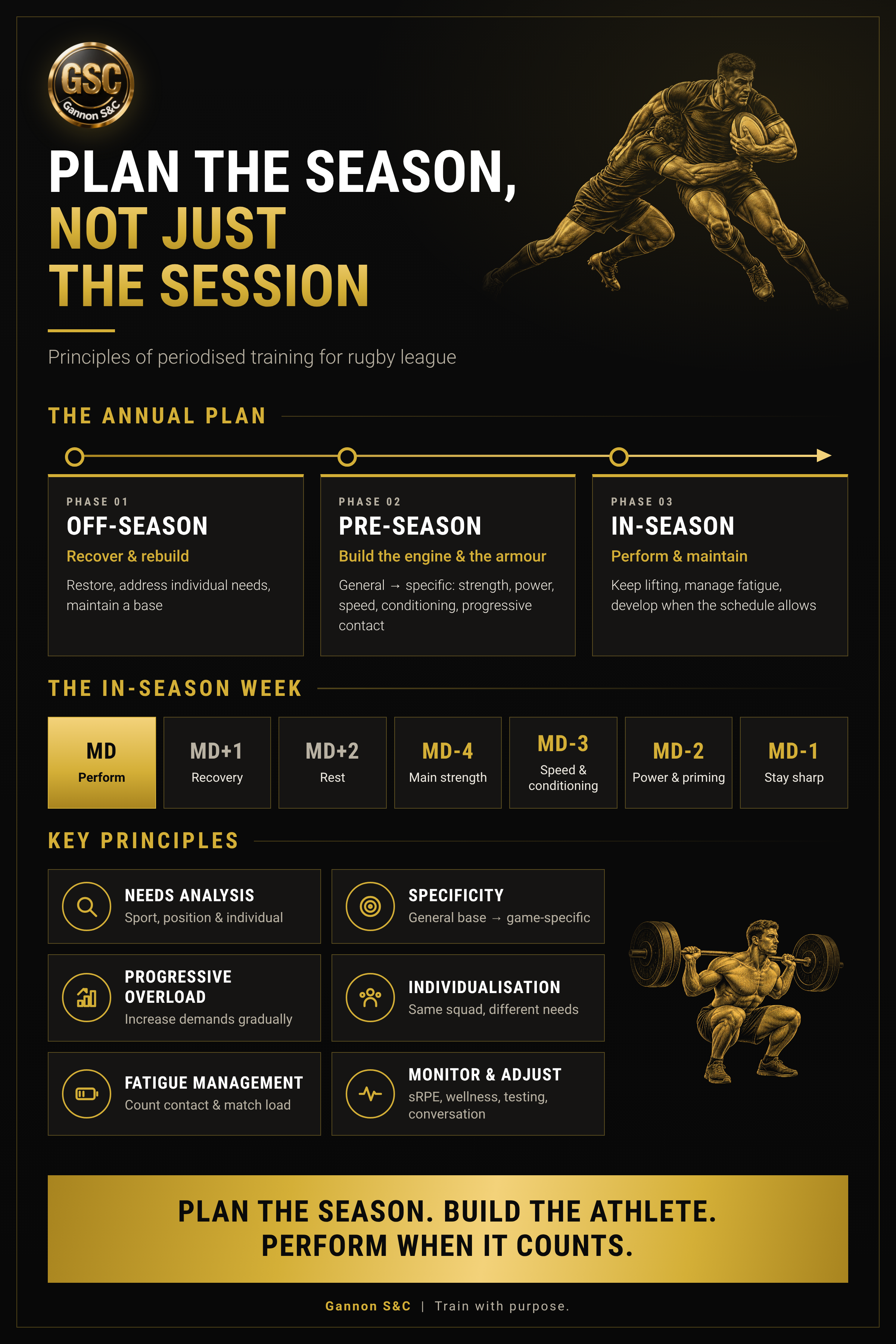
Plan the Season, Not Just the Session: Periodised Training for Rugby League
Rugby league asks a lot of a body. Players need to accelerate, change direction, tackle, carry, get back onside and go again, often with very little recovery. They need strength to win collisions, speed to break the line and conditioning to keep doing it late in the game. They need to do this week after week across a long season.
No single training session can develop all of that. A training plan that works is built over months, not days. That is what periodisation is about.
This article is for coaches who programme for players and for players who manage their own training. The principles are the same for both groups. What changes is how you apply them.
What periodisation actually means
Periodisation is the planned organisation of training over time. You divide the year into phases, and each phase has a clear purpose. Training load, emphasis and exercise selection change from one phase to the next so that the right qualities develop at the right time and fatigue stays under control.
It is not a fixed template, a particular spreadsheet or a promise that every player will peak on a given date. It is a way of thinking: know where you are going, plan how to get there and adjust as you go.
Training is usually planned at three levels:
Macrocycle: the long view, usually the full season or year.
Mesocycle: a block of several weeks with a specific focus, such as building strength or developing speed.
Microcycle: usually one week. In rugby league, this is normally organised around the next fixture.
The long-term plan sets the direction. The weekly plan does most of the work.
Start with a needs analysis
Before you choose an exercise or write a block, understand two things: the demands of the sport and the needs of the individual.
The sport. Rugby league is an intermittent collision sport. It combines high-speed running, repeated high-intensity efforts, wrestling and contact, with lower-intensity periods in between. Demands differ by position. Middles generally take part in more collisions. Outside backs often cover more high-speed distance. Halves and hookers have their own specific movement and decision-making demands.
The athlete. Training age, strength levels, speed, aerobic fitness, injury history, availability, age, lifestyle and how they respond to training all matter. A 19-year-old in their first full-time pre-season needs a different plan from a 31-year-old forward who has played more than 200 games.
The needs analysis turns the question "What should we train?" into "What does this player need to develop, and in what order?"
The principles that hold it together
Whatever model you use, the same underlying principles apply.
Specificity. Adaptations reflect the training performed. General qualities such as strength and aerobic fitness are a foundation. As the season approaches, training should become more closely related to the demands of the game.
Overload and progression. Improvement requires a challenge that is gradually increased. You can do this by adjusting load, volume, intensity, density or complexity. Increase demands at a rate the athlete can tolerate. Different tissues adapt at different rates, so big jumps in training load are best avoided.
Variation. Changing emphasis between blocks helps adaptation continue and reduces staleness. Variation should have a purpose. It is not a reason to change exercises every week.
Individualisation. Players in the same squad respond differently to the same programme. Group plans are practical, but leave room to adjust them.
Recovery and fatigue management. Adaptation happens when training stress is balanced with recovery. In a collision sport, fatigue from matches and contact training must be included in the plan.
Reversibility. Qualities that are not trained will decline over time. This is why strength and speed should not be abandoned once the season starts.
The annual plan: three broad phases
Competition calendars differ between levels. Fixture lists and club structures differ too. Still, most rugby league years can be divided into three broad phases.
1. Off-season: recover and rebuild
After a long season, players need to recover physically and mentally. A short period of reduced training lets niggles settle and lowers accumulated fatigue.
That does not mean doing nothing for weeks. Low-volume general activity and well-chosen strength work help limit losses before pre-season. This is also a good time to address individual priorities, such as movement limitations, rehabilitation or underdeveloped qualities, without the pressure of a match week.
Emphasis: recovery, restoration, addressing individual needs and maintaining a base.
2. Pre-season: build the engine and the armour
Pre-season is usually the main opportunity to develop physical qualities. It often moves from general to more specific work.
General preparation. Build work capacity, aerobic fitness, muscle size where needed and foundational strength. Training volumes are typically higher, and technical competency in key lifts and running mechanics is reinforced.
Specific preparation. Gradually shift towards maximal strength, power, speed and conditioning that reflects the repeated high-intensity demands of the game. Introduce contact and collision work progressively, including tackling, wrestling and getting up off the ground. Do not drop them into training all at once.
As the first fixture approaches, training volume usually reduces while intensity and specificity rise. The aim is for players to arrive at round one fit, robust and fresh enough to perform.
Emphasis: develop strength, power, speed and conditioning, then make them specific to rugby league.
3. In-season: perform, maintain and keep developing where you can
The in-season phase is long. Treating it as one block of "maintenance" leaves performance on the table, especially for younger players or those with less training experience, who may still be able to make gains.
The main challenge is balance. Players need enough training stimulus to keep strength, speed and fitness, plus enough recovery to perform at the weekend. Strength training usually continues throughout the season, typically with lower volume but meaningful intensity, so that qualities built in pre-season are not lost.
Some phases of the season may allow more development, such as longer turnarounds, breaks between fixtures or periods when a player is not selected. Others will need more caution, such as congested fixtures or short turnarounds. Players who are not getting regular game time need extra conditioning and training to make up for the match load they are missing.
Emphasis: match performance, keeping strength, speed and fitness, managing fatigue and developing qualities when the schedule allows.
The in-season week: planning around the match
In rugby league, the fixture usually sets the structure of the week. Many programmes organise training by counting days from the match: MD+1, MD+2, MD-1 and so on.
Here is a typical outline for a standard seven-day turnaround. It is a starting point, not a prescription:
| Day | General emphasis |
|---|---|
| Match day (MD) | Perform |
| MD+1 | Recovery: low-intensity movement, mobility and review |
| MD+2 | Rest or very light activity |
| MD-4 | Main strength session, with higher-volume field training where appropriate |
| MD-3 | Speed, power and rugby-specific conditioning |
| MD-2 | Lower-volume power or priming work, with tactical emphasis |
| MD-1 | Short, sharp session: stay fresh and ready |
The basic logic is to place the most demanding work far enough from the previous match to allow recovery, and far enough from the next one so players are fresh. As the next fixture gets closer, training volume reduces, and the work stays sharp and high-quality.
Shorter turnarounds compress this structure. When there are fewer days between matches, recovery becomes the priority and some development work may have to wait. Longer turnarounds give you room to load players harder.
Which model? Linear, block or undulating
Coaches often debate periodisation models:
Traditional (linear): gradually moving from higher volume and lower intensity to lower volume and higher intensity.
Block: concentrated phases that target a smaller number of qualities at a time.
Undulating: varying emphasis, volume and intensity more frequently, sometimes within a week.
Each approach has merit. In practice, many rugby league programmes combine them: a more traditional build across pre-season, focused blocks for specific priorities and a varied weekly structure in-season.
The best model is the one that fits your athletes, your calendar and your environment, and that you will apply consistently and adjust based on evidence.
Monitor, review and adjust
A plan is a hypothesis. Monitoring tells you whether it is working.
Useful tools include:
Training load: session RPE (rating of perceived exertion multiplied by session duration), running data where available and lifting records.
Wellness and readiness: sleep, soreness, mood and fatigue questionnaires.
Performance testing: periodic strength, speed, jump and fitness tests at sensible points in the year.
Conversation: how the player feels, what they are dealing with outside training and what the coach is observing.
The aim is not to collect data for its own sake. Look for trends, spot problems early and make informed decisions, such as reducing the load for a fatigued player or pushing a player who is coping well.
For players: making it work for you
If you manage your own training, or train alongside a club programme, these principles still apply:
Know your calendar. Plan your training around your fixtures, not the other way round.
Keep lifting in-season. Shorter sessions are fine. Stopping is not the answer.
Do your heaviest work early in the week and keep the days before a match lighter.
Record what you do. A training log helps you spot progress and overload.
Protect your recovery. Sleep, nutrition and recovery days are part of the programme.
Communicate. Tell your coach about niggles, poor sleep, work stress or extra training you are doing elsewhere.
Do not chase the session that made you feel destroyed. Being exhausted is not the same as being well prepared.
For coaches: keep the plan useful
Start with the needs analysis and revisit it.
Set clear objectives for each block.
Build in progression and planned lighter periods.
Account for contact and match load, not just gym and running volume.
Keep the plan flexible enough to cope with selection changes, injuries, weather and fixture changes.
Review each block honestly and use what you learn in the next one.
The bottom line
Rugby league is a long season played by athletes with very different needs. Periodisation gives your training direction: building qualities in the right order, keeping them during competition and managing fatigue so players can perform when it counts.
It does not need to be complicated. It does need to be deliberate.
Plan the season. Build the athlete. Perform when it counts.
Gannon S&C